
This policy brief addresses the issue of Yemen’s bloated public sector. Due to decades of corruption and patronage appointments, among other factors, public sector salaries were already a source of fiscal stress prior to the ongoing war. Previous efforts to downsize the public sector, notably those supported by the World Bank, produced few tangible results, as this brief outlines. During the conflict, the internationally recognized Yemeni government and the armed Houthi movement have added to the public sector payroll — particularly in the military and security apparatus — as the economy has contracted. Amid consistently large budget deficits, the inflated public sector wage bill is fiscally unsustainable and threatens to undermine economic recovery and future stability in Yemen.
This policy brief offers recommendations to reduce the public sector wage bill in Yemen, taking into consideration lessons learned from previous failures. Recognizing the multiple challenges of reforming the public sector, even in a stable country, these recommendations are addressed to the post-conflict government. It is recommended that the post-conflict government should: conduct an assessment to evaluate the conflict-driven growth of the public sector payroll; reduce administrative corruption through the biometric registration of all public sector workers; and develop a strategy to demobilize and reintegrate fighters into society without absorbing them into the public sector. It also recommends medium to long-term reforms to achieve a fiscally sustainable, efficient public sector, including an audit of public services, payroll reduction through attrition and the development of transparent hiring procedures.
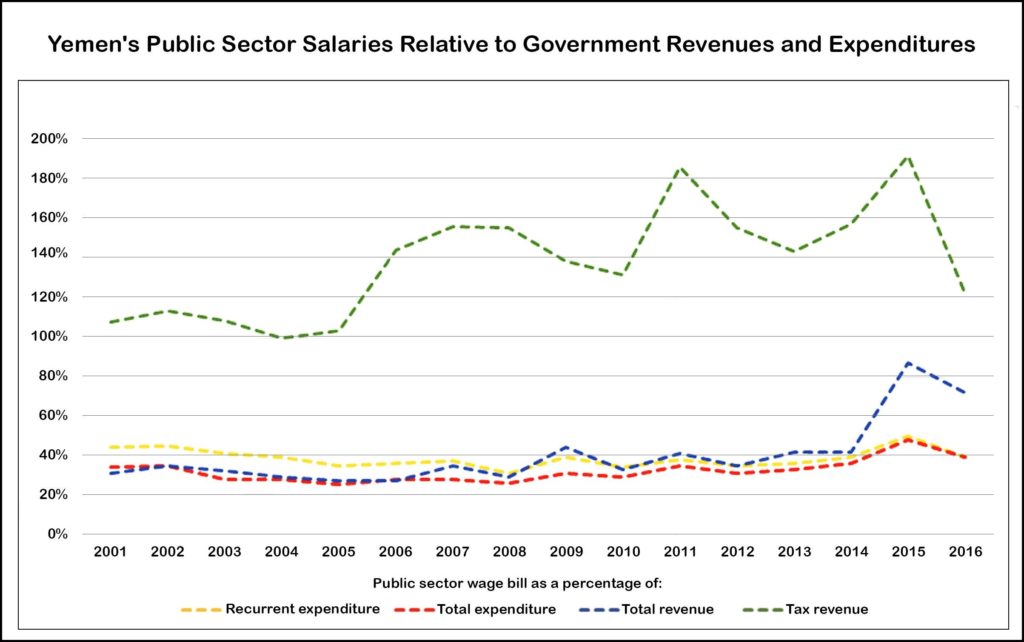
Yemen’s bloated public sector employment was a strain on the state budget prior to the conflict, accounting for an average of 32 percent of government spending between 2001 and 2014.[1] During the conflict, the warring parties have added large numbers of new employees to the public payroll, particularly the military and security services, while Yemen’s economy has shrunk.[2] Yemen is also struggling with a large public budget deficit, which was estimated at 660 billion Yemeni rials in 2018, equivalent to US$1.24 billion (at the average US$/YR exchange rate for 2018).[3] Post-conflict, reconstruction will be a priority for public expenditure and external support; Yemen may struggle to find consistent funding for public sector salaries.
Amid a liquidity crisis, the Central Bank of Yemen stopped distributing salaries in August 2016. Salary payments in some areas and sectors have since resumed, but full, regular payments to all public sector employees have not yet been achieved.[4] While resuming salary payments to civil servants is an urgent priority to help relieve the humanitarian crisis in Yemen, the inflation of the public sector is a looming crisis that must be addressed if Yemen is to achieve economic stability in the future. Post-conflict Yemen will also have to grapple with the reintegration of tens of thousands of fighters employed by the warring parties. It will not be fiscally viable to integrate them all into the state military and security bodies; however, other provisions for these fighters must be made in order to ensure they do not become spoilers to the peace process.
The bloating of Yemen’s public sector is the cumulative outcome of several decades of mismanaged public sector employment policies as well as multiple forms of administrative corruption. In 1990, the unification of North Yemen and South Yemen led to the merging of two public sectors, both of which were swollen by state employment policies that did not take into account the actual needs of public institutions. Former President Ali Abdullah Saleh and his regime used public sector employment as a direct form of patronage throughout his 33 years in office, particularly within the military and security apparatus. Saleh’s regime’s use of public sector employment as a political tool continued to the end of his presidency; in 2011, the beleaguered president issued a decree to employ 60,000 university graduates and holders of post-secondary diplomas to try and stem the rising tide of opposition.[5]
Yemen’s public sector workforce has long included a high-number of ‘ghost workers’ – individuals that either do not report for duty or do not exist – and ‘double dippers’, who take multiple salaries from different public sector sources. Under Saleh, military and security leaders were given money and equipment according to the number of soldiers under their command, leading them to inflate the numbers of soldiers they commanded.[6] They would then receive extra salaries and equipment which could be sold on the black market or used for other purposes, such as bribery etc. After Saleh stood down as president in February 2012, various political actors within the transitional government headed by President Abdo Rabbu Mansour Hadi looked to strengthen their support bases as they jockeyed for positions. One way to achieve this was by gifting public sector employment.[7]
After the armed Houthi movement (Ansar Allah), supported by forces loyal to Saleh, captured Sana’a in September 2014 and forced President Hadi into exile in March 2015, the Houthi authorities pursued their own targeted, public sector employment strategy.[8] This has included the replacement of long-serving public sector employees in Sana’a-based ministries (particularly the ministries of defense and interior) and other state institutions with handpicked Houthi supporters. The Houthi authorities have also appointed civilian, military, and security officials who are not on the official payroll.
As is the case with a number of armed groups that are active in the conflict, there are Houthi-affiliated fighters receiving salaries who are not registered. Added to this, a number of military and security officials within the movement’s ranks have been rapidly promoted. Meanwhile, tens of thousands of fighters have been integrated into the internationally recognized Yemeni government’s military and security apparatus, and military personnel have received their monthly salaries on a more regular basis than civilian public sector employees. Due to the lack of transparency and questionable payroll payment procedures, it is widely believed that military commanders continue to inflate the number of men under their command in order to receive salary payments for these ‘ghost soldiers’.[9] A major contributing factor on the Yemeni government side is the presence of two wealthy patrons, Saudi Arabia and the United Arab Emirates (UAE). While Riyadh bankrolls the forces operating under the command of the Yemeni government, Abu Dhabi pays the salaries for the local security forces it helped establish that operate in Aden, Abyan, Shabwa and Hadramawt. Members of the UAE-backed Security Belt Forces in Aden are known to receive two salaries – one from the UAE and another from the Yemeni government.[10]
In the event of a peace deal, former fighters will need to be reintegrated into civilian life; if left armed and without salaries, they could become spoilers to the peace process. It will not be fiscally sustainable to absorb all fighters into the state military and security forces post-conflict. Thus, adequate support and incentives must be provided in the form of a national rehabilitation and reintegration program that incorporates fighters into the labor force. Fighters are driven by multiple factors, including unemployment, economic malaise and despair, as well as ideological beliefs; while fighters should not be integrated en masse into the public sector, bringing them into the workforce will be critical to the long-term stability of Yemen, and the wider region.
Public sector salaries in Chapter 1 of the internationally recognized Yemeni government’s budget for 2019 account for 39.33 percent of projected expenditure. Salaries for some state funds and independent units are not included in Chapter 1 of the budget, so this figure does not reflect full government wage expenditure. [11]
Figure (1): Government spending on Chapter 1 public sector wages (millions, Yemeni rials)*
| Item | Military & Security | Civilian | Total Cost |
| 2014 Budget | 430,212 | 546,873 | 977,085 |
| 2018 Expenditure | 558,181 | 271,064 | 829,245** |
| 2019 Budget | 528,629 | 694,896 | 1,223,525 |
Source: Ministry of Finance, Government of Yemen
*All figures are rounded to the nearest million.
** This figure is lower than 2014 because the Yemeni government only paid salaries to 51 percent of civil service employees in 2018.
The projected expenditure for 2019 does not, however, include those in military and security units in Houthi-controlled areas, nor those appointed by the Houthi authorities during the conflict. Houthi authorities have appointed staff to ministries in Sana’a and to institutions they control, including the Yemen Petroleum Company (YPC) and the Red Sea Ports Corporation. The Houthi authorities have also created new bodies, such as the National Authority for the Management and Coordination of Humanitarian Affairs and Disaster Recovery (NAMCHA) that oversees coordination among different humanitarian organizations and aid programs. A number of people are also employed by the Houthis in informal positions or in quasi-state institutions, such as those operating under the umbrella of the Supreme Revolutionary Committee and the Houthi-appointed supervisors or “mushrifs” as they are referred to locally. While accurate statistics on the current number of public sector employees in Yemen are not available, it is clear that the size of the payroll has grown since 2014, when it stood at 1.25 million.
Previous costly efforts to implement reforms and address the corruption that has inflated Yemen’s public sector wage bill have failed to produce tangible results. In the early years of the new republic, the Yemeni government used salary cuts to try and reduce its wage bill, which had increased with the merging of two public sectors after unification in 1990. By 1996, average real wages for public sector staff had been cut to 15 percent of their 1990 levels, and senior managers earned just 11 percent of the salaries of their private sector peers.[12] These low wages encouraged absenteeism and low productivity, as well as practices like double dipping, ghost workers and corruption.
In 1998, the Yemeni government adopted the Strategic Framework for Civil Service Modernization to restructure public employment, establish a transparent personnel management system and reduce the number of redundant workers, among other aims. The World Bank supported the government’s reform agenda with a range of financing mechanisms, including a flagship US$30 million project approved in April 2000 to put in place personnel and financial management systems, remove 34,000 redundant employees and remove all double dippers and ghost workers from public employment, among other objectives.
A decade later, the Civil Service Modernization Project had identified 17,753 redundant employees, mostly from defunct state enterprises. In addition, 3,792 double dippers had been removed from the payroll, of whom 3,767 had come forward voluntarily while just 25 were identified through databases developed by the project.[13] No ghost workers had been identified. The project also aimed to streamline organisational structures in ministries, but there was little evidence of implementation or results in this area, according to the World Bank’s evaluation. Overall, the project failed to reduce the number of civil servants or the size of the wage bill, which doubled from 281 billion Yemeni rials in 2005 to 597 billion Yemeni rials in 2010.[14]
The World Bank’s internal evaluation concluded that the project was overambitious in scope and sophistication, and underestimated the sensitivity and inherent political nature of the reforms, as well as the welfare, cohesion and patronage functions of the public sector in Yemen.[15] The attempted reforms were also hindered by weak inter-ministerial coordination; an absence of government commitment to reform; poor donor coordination; an unstable political and security situation, which affected the government’s authority and capacity to push reforms in some areas; weak governance, including continuing corruption and patronage; pressure from regional and tribal constituencies that relied on public sector employment in the absence of a strong labor market; and resistance to the establishment of a central civil service database and management systems in some decentralized governorates.
Law no. 43 of 2005 introduced a requirement to establish a civil service biometric fingerprint system and a central database of employees at the Ministry of Civil Service. However, this process was hampered by hardware and software limitations and, later, damage to technical infrastructure during the 2011 uprising.[16] The computer equipment and software only had the capacity to register 500,000 state employees, and there was insufficient budget allocated to upgrade the biometric system.[17] As the system was not linked to time and attendance software, it could not be used to identify ghost workers. Additionally, it was not integrated with payroll databases.[18] In 2013, the Yemeni government announced that it would implement a new program to remove ghost workers and double dippers from the civil, military and security services, supported by the UN Development Program.[19] The plans included restoring the databases, as well as upgrading the storage capacity of the database so all government employees could be registered. Yet, until now, biometric information that has been collected remains as raw data, and the databases that have been created only have the capacity to identify duplicate names.
Addressing a bloated public sector is a significant and demanding undertaking that requires sustained political will, public buy-in and adequate institutional capacity and resources, even in a stable country. For a country at war, reforms may face insurmountable challenges and thus the following recommendations are focused on a post-conflict scenario. These recommendations take lessons learned into account and advocate for a phased, gradual approach to each step.
footnotes
[1] In 2014, public sector salaries cost the government 1.14 trillion Yemeni rials, which at the time was equivalent to $5,3 billion. See: Mansour Ali Al Bashiri, “Economic Confidence-Building Measures — Civil Servant Salaries,” Rethinking Yemen’s Economy, March 18, 2019, https://devchampions.org/publications/policy-brief/civil-servant-salaries.
[2] The World Bank estimated in April 2019 that Yemen’s GDP had contracted by an accumulated 39 percent since the end of 2014. See: “Yemen’s Economic Update,” World Bank, April 2019, http://pubdocs.worldbank.org/en/365711553672401737/Yemen-MEU-April-2019-Eng.pdf. Accessed June 20, 2019.
[3] “Starvation, Diplomacy and Ruthless Friends: The Yemen Annual Review 2018,” Sana’a Center for Strategic Studies, January 22, 2019, http://sanaacenter.org/publications/the-yemen-review/6808#ED-macro. Accessed June 20, 2019.
[4] “Economic Confidence Building Measures – Civil Servant Salaries,” Rethinking Yemen’s Economy, March 18, 2019, https://devchampions.org/publications/policy-brief/civil-servant-salaries. Accessed July 23, 2019.
[5] Farea Al-Muslimi and Mansour Rageh, “Yemen’s economic collapse and impending famine: The necessary immediate steps to avoid worst-case scenarios,” Sana’a Center for Strategic Studies, October 2015, http://sanaacenter.org/wp-content/uploads/2015/11/files_yemens_economic_collapse_and_impending_famine_en.pdf. Accessed June 19, 2019.
[6] “Beyond the Business as Usual Approach: Combating Corruption in Yemen,” Rethinking Yemen’s Economy, November 2018, http://sanaacenter.org/files/Rethinking_Yemens_Economy_No4_En.pdf. Accessed June 19, 2019.
[7] Peter Salisbury, “Corruption in Yemen: Maintaining the Status Quo?” in Rebuilding Yemen: Political, Economic, and Social Challengers, ed. Noel Brehony and Saud al-Sarhan (Berlin: Gerlach Press, 2015)
[8] “Beyond the Business as Usual Approach: Combating Corruption in Yemen,” Rethinking Yemen’s Economy, November 2018, http://sanaacenter.org/files/Rethinking_Yemens_Economy_No4_En.pdf. Accessed June 19, 2019.
[9] Ibid.
[10] Although members of the UAE-backed Security Belt Forces in Aden operate under the direct control of the UAE, they are formally registered with the Government of Yemen’s Ministry of Interior, and thus receive a monthly salary from both the UAE and the government.
[11] Chapter 1, 2019 Budget for Government of Yemen
[12] “Implementation completion and results report on a credit in the amount of SDR 22.4 million to the Republic of Yemen for a civil service modernisation project,” The World Bank, December 2010, http://documents.worldbank.org/curated/en/206391468340752501/text/ICR16880P050701OFFICIAL0USE0ONLY191.txt. Accessed June 20, 2019.
[13] Ibid.
[14] Ibid.
[15] Ibid.
[16] “Action Plan to Implement the Program to Remove Ghost Workers and Double Dippers in the Civil Service System, Including the Military and Security,” Government of Yemen, https://www.undp.org/content/dam/yemen/DemDov/Docs/UNDP-YEM-biometric_en_Final.pdf. Accessed June 19, 2019.
[17] Ibid.
[18] Ibid.
[19] Ibid.
Executive Summary
This paper examines governance as the decisive factor shaping the success or failure of government reforms and current government plans in Yemen. It starts from a central premise: Yemen’s reform crisis is not primarily a crisis of planning or vision, but a crisis of structural weakness in the governance system that should regulate policy design, implementation, monitoring, and accountability. Yemeni experience, before and during the war, shows that reforms without a clear governance framework become formal decisions that are selectively implemented, stripped of substance, or unable to deliver sustainable impact.
The paper demonstrates that the implementation gap represents the central challenge facing government reforms—a gap resulting from overlapping mandates, multiple decision-making centers, weak institutional coordination, absence of effective accountability, lack of transparency and data, as well as the chronic disconnect between financial and institutional reforms. It also shows that corruption in the Yemeni context is no longer an isolated administrative phenomenon but has become part of deeper dysfunctions in the state’s political economy, making its treatment possible only through comprehensive governance reforms, not through discrete oversight tools.
Through analysis of a case study involving clearly formulated reforms that later stalled in implementation, the paper concludes that political decisions alone are not enough to ensure execution in the absence of an integrated governance system. Weak effective executive authority, the absence of a clear accountability chain, undeclared institutional resistance, and poor alignment between reforms and institutional capacities all contribute to disruption and operational paralysis.
Based on this diagnosis, the paper proposes a practical governance framework for reforms in Yemen. The framework treats reform as a continuous political-institutional process rather than an isolated technical or financial intervention. It is built on the need for a unified national reference for reform governance, clear mechanisms for assigning roles across institutions, a workable balance between centralization and local governance, and the integration of transparency and information systems at the core of the reform cycle. It also adopts a gradual approach that builds trust and reduces implementation resistance.
In light of this framework, the paper presents a package of practical recommendations to strengthen the governance of government reforms. These include adopting a unified national framework for institutional performance governance, strengthening financial governance through budget discipline and expenditure control, establishing a unified digital data system, and activating central and local accountability mechanisms based on clear performance standards, while also allowing regulated exceptional tools for economic crisis management. The paper emphasizes that these recommendations can succeed only through clear role distribution among the central government, local authorities, the private sector, civil society, and international partners, within a single national framework that leads the reform process without replacing state institutions.
The paper concludes that governance is not a procedural issue or an external condition, but rather the most realistic entry point for reconsidering government plans and transforming them into effective tools for economic recovery and institutional stability. Without systematically addressing governance gaps, government reforms will remain vulnerable to stumbling regardless of their technical quality or the support allocated to them. Building a clear and implementable governance system represents a genuine opportunity to rebuild trust between the state and society, improve resource utilization efficiency, and put Yemen on a more sustainable reform path.
Why this paper now?
The Yemeni government today does not primarily suffer from a lack of plans or weak vision; it suffers from a chronic inability to convert approved decisions and plans into tangible results. Experience shows that this pattern undermines the credibility of political decision-making and reduces reforms to low-cost rhetorical commitments for actors who do not intend to comply.
What does this paper show?
This paper proceeds from a clear premise: the reform crisis in Yemen is a governance implementation crisis, not a policy crisis. Government reforms, regardless of their technical quality or political level, will not be automatically implemented in the absence of a governance framework linking decision, implementing entity, resources, follow-up, and accountability.
What does political decision-making require now?
Addressing this gap does not require launching new plans. It requires specific decisions that reorganize how reforms themselves are managed, strengthen the implementation and accountability chain, and protect political decisions from undeclared institutional disruption.
Risks of inaction
Continuing the current situation means the persistence of implementation gaps, erosion of domestic and international confidence, and transformation of reforms into accumulated political and administrative burdens. This paper presents a practical framework for reform governance without creating parallel structures or suspending accountability rules, preserving the role of state institutions and enhancing their implementation capacity.
Executive Summary
The Republic of Yemen today faces one of the most complex investment environments in the region. This reality is the result of structural weaknesses that predated the war and were then intensified by political and institutional fragmentation, security deterioration, and economic collapse. Even so, international experience in fragile and conflict-affected states suggests that Yemen can combine high levels of risk with promising investment opportunities in sectors that can operate before full peace is achieved – provided that reforms are clear, political will exists domestically, and regional support is active.
Over the past decade, the war has produced financial and monetary fragmentation, multiple decisionmaking centers, and divergent laws and procedures. This has created two distinct economic environments: one in government-controlled (liberated) areas and another in Houthi-controlled areas. The result has been a sharp decline in confidence, weaker institutions, severe deterioration in purchasing power, and a continuing fall in the Riyal’s value, alongside rising operating, transport, and insurance costs. At the same time, many of these constraints predate the war: even before the conflict, Yemen was a difficult investment environment due to corruption, complex procedures, a weak judiciary, widespread illegal levies, and capture of state resources by influential power centers.
Despite this bleak picture, the regional and international context offers encouraging indicators that investment space can still be created, especially in government-controlled (liberated) governorates. Compared with Houthi-controlled areas, these governorates offer internationally recognized legal authority, open ports, limited but workable banking channels through official institutions, and stronger prospects for investor protection through international arbitration.
International experience in Iraq, Lebanon, Rwanda, and other conflict-affected countries shows that investment can begin gradually in sectors least affected by war, and that success in fragile environments depends on four pillars: understanding risks while limiting exposure, strong risk management, clear government reforms, and organized regional and international support. With current Gulf investment shifts toward Iraq, Lebanon, and Syria, Yemen – given its geostrategic location along major trade routes, its young population, and its strategic relevance to Gulf security – is a logical candidate to attract part of these investment flows.
There are also conflict-compatible sectors that can be entered today, such as:
These sectors operate by their nature in unstable environments and do not require comprehensive national stability, and can be a starting point.
The paper emphasizes that investment in Yemen, at this stage, cannot be treated as an unrestricted open
field. It must be governed by clear requirements, including a government commitment to supporting
investment, legislative reform, procedure digitization, elimination of illegal levies, access to international
arbitration, specialized government units for investor services, and the launch of a unified investment
window in Aden. It also requires regional guarantees and practical enablers through direct partnerships
with Saudi Arabia, the United Arab Emirates, and other Gulf countries.
Foreign investment also requires active participation by the Yemeni private sector through alliances,
stronger governance standards, audited financial statements, and partnerships with Gulf investors through joint ventures (JVs) rather than stand-alone efforts. It also calls for a new donor role that goes beyond relief to support joint investment, improve the business environment, and provide financing guarantees and blended-finance tools.
Geographically, while the analysis covers Yemen as a whole, the practical application of opportunities
focuses on government-controlled (liberated) governorates. This reflects the current impracticality of
operating in the Houthi-controlled environment, which is marked by sanctions, extortion, capital flight,
institutional destruction, tight control over companies, and the absence of minimum legal and institutional guarantees for local and foreign investors.
The paper concludes that Yemen, despite its fragility, possesses rare strength elements in the region,
including:
The paper presents practical recommendations for the Yemeni government, the Yemeni and Gulf private
sectors, and donors aimed at transforming Yemen’s investment environment from a deterrent environment into an enabling one through short- and medium-term reforms, strategic partnerships, and a limited number of high-impact model projects that can build confidence and unlock larger investment flows later.
Based on this analysis, foreign investment in Yemen is difficult but not impossible. In the right regional
context and with clear government reforms, it can become a major driver of economic stability, a lever for reconstruction, and a tool for integrating Yemen into the Gulf and wider regional economy. The most logical starting point is in government-controlled (liberated) governorates and in sectors compatible with the current conflict context, before moving to larger projects in a later political settlement phase.
The war has fundamentally altered Yemen’s trade finance system, transforming it from a reliable, unified, bank-led mechanism into several divergent, conflicting structures that have made import financing cumbersome, costly, and unstable. The conflict has led to the suspension of oil and gas exports — the country’s primary source of revenue and foreign currency — and resulted in the division of key economic institutions across regional zones of control. Specifically, the fragmentation of the Central Bank of Yemen (CBY) into rival branches (Sana’a and Aden) and the subsequent prevalence of dual currency and monetary systems has created a complex trade financing landscape. The two branches have engaged in a power struggle, issuing conflicting monetary and financial policies that weaponize all aspects of import regulation and financing.
The collapse of the formal banking system, combined with liquidity shortages, has eroded confidence in banks’ financial services and entrenched the rise of less-regulated financial transfer networks, which dominate the monetary cycle and trade facilitation. The fragmented regulatory environment has heightened the country’s vulnerability to global de-risking measures and exposed it to severe risks related to Anti-Money Laundering/Countering the Financing of Terrorism (AML/CFT) requirements. Yemeni banks have struggled to access foreign correspondent banks, which has inflated import costs and exacerbated food insecurity in a country that imports up to 90 percent of its basic staples from abroad.
The US designation of the Houthis as a Foreign Terrorist Organization (FTO) and subsequent sanctions catalyzed a significant shift away from Yemen’s historically centralized financial system. The sanctions forced banks to relocate to government-controlled areas, eliminating the Houthis’ dominance over their primary operations. Today, these relocated banks are facing operational challenges due to the historic centrality of the financial system, the commercial market, and customer base in Houthi-controlled areas.
After the failure of several import financing mechanisms, the internationally recognized government, along with the Central Bank of Yemen in Aden (CBY-Aden), has recently begun implementing much-anticipated economic reforms that have stabilized the Yemeni rial. These reforms helped institutionalize a new mechanism for trade finance, culminating in the establishment of the National Committee for Regulating and Financing Imports.
To effectively operate on the ground, the Import Committee and CBY-Aden need to be fully empowered to curb currency destabilization and secure hard currency inflows, and to use those funds to finance basic commodity imports. The government should create a conducive business environment for banks to provide financial services and facilitate trade nationwide. Additionally, it should shift from short-term collective measures to long-term economic reforms. These should include working to access sustainable sources of hard currency to finance trade. Sustained financial support from Saudi Arabia and other donors is critical to replenishing the CBY-Aden’s foreign reserves and preserving the value of the rial.
Close coordination with international financial institutions and US decisionmaking bodies (such as the Department of the Treasury’s Office of Foreign Assets Control) is essential to enhance Yemeni banks’ capacity to comply with AML/CFT standards. Houthi authorities must suspend punitive measures against banks and traders and refrain from any future actions that could further deepen the monetary division and complicate trade financing.
In parallel, the UN and broader international community should exert immediate pressure on the warring parties to halt their weaponization of trade financing and respect the neutrality of the banking sector. They should help establish sanctions safeguards to protect humanitarian and remittance flows. As circumstances improve, the international community should support the creation of a nationwide trade financing scheme that is technically effective and insulated from political conflict.
Yemen’s e-commerce sector holds significant potential to drive economic growth and financial inclusion, particularly for women and rural communities, but faces major challenges, including poor internet connectivity, limited digital payment systems, and the absence of legal and regulatory frameworks. The country remains heavily cash-based, with minimal access to formal banking and fragmented oversight, exposing consumers and providers to fraud and limiting sector development. Internet infrastructure is among the worst globally, with only 17.7 percent of the population online in 2024, though the recent introduction of Starlink offers hope for improved connectivity. Conflict-related damage to transportation networks further hinders delivery services. Despite these obstacles, some businesses have found success, especially in urban areas, by adapting to logistical constraints. Yemen’s youthful, increasingly smartphone-connected population, along with emerging technologies and business models, offers promising opportunities for inclusive e-commerce growth—provided that policymakers invest in digital infrastructure, enact protective regulations, and create a supportive environment for online enterprise.
Historically, Yemen’s industrial sector has been characterized by small-scale, private initiatives, with 78% of establishments employing fewer than four workers and dominated by food, metal, and textile industries. Yemeni industry’s reliance on imported inputs and weak infrastructure left it vulnerable even before the 2015 escalation of war. Post-conflict damage has been extensive, with losses exceeding $35 billion, industrial output collapsing, and over half the workforce displaced. Legal frameworks exist but lack consistent enforcement. Gender disparities remain stark, with women accounting for just 1–6% of industrial employment. Environmental degradation further complicates recovery, driven by outdated laws and limited compliance capacity.
Despite this, some local industries have demonstrated resilience, particularly in informal light manufacturing. Drawing from regional and international models of industrialization, this RYE Policy Brief identifies viable paths for industrial renewal anchored in local resources, community participation, and adaptive governance.
Develop a national industrial strategy in partnership with the private sector, including identification of key sectors, support measures, and coordination mechanisms.
Simplify business registration, update laws, and establish industrial arbitration councils.
Expand training, develop women-friendly zones, and launch targeted financing for female entrepreneurs.
Fund industrial research labs and foster private-sector innovation partnerships.
Rehabilitate industrial zones with solar energy, logistics hubs, and streamlined port access.
Create an Industrial Finance Fund and expand concessional credit for SMEs.
Enforce pollution controls, incentivize clean tech adoption, and integrate safeguards into industrial planning.
Yemen is vulnerable to climate change and affected by ongoing conflict, facing worsening environmental crises such as water scarcity, degradation of arable land, and an increasing frequency of extreme weather events. The country’s capacity to address the impact of climate change is severely hampered by limited access to international climate finance. Obstacles include the absence of clear criteria for fund distribution, bureaucratic complexities that exceed local institutional capacity, an emphasis on mitigation over adaptation measures, and a preference for providing loans over grants. Fragmented governance and a decade-long climate data gap further undermine the country’s eligibility for funding. Yemen lacks accredited national institutions capable of directly accessing climate funds, which forces it to rely on international non-governmental organizations (INGOs). This reliance introduces additional layers of bureaucracy and high transaction costs.
This policy brief, based on a desk review and a two-day workshop held in Amman, Jordan, in November 2024, examines Yemen’s climate finance barriers and explores opportunities for improving its access to climate finance. The paper highlights funding allocation disparities, in which climate-vulnerable and fragile states receive disproportionately low shares of climate finance. For instance, Yemen received a mere US$0.60 per capita in adaptation finance between 2015 and 2021, compared to over US$100 per capita in stable countries during the same period.
The paper draws lessons from other countries, including Rwanda, Somalia, and Bangladesh, which improved access by utilizing national climate funds, engaging in diplomatic advocacy, and implementing community-based data initiatives. Recommendations emphasize urgent actions for Yemen’s government, including establishing a multi-stakeholder climate task force and climate fund, finalizing Nationally Determined Contributions (NDCs), and enhancing regional cooperation. For international actors, reforms such as simplifying accreditation processes, prioritizing grants, and supporting climate diplomacy are critical.